How to Teach Fractions at Home Using Everyday Objects
Start teaching fractions with equal parts of a whole, then connect the objects or drawings to fraction notation. The important first question is not simply how many pieces there are, but whether the pieces are equal.
Begin with one clearly defined whole
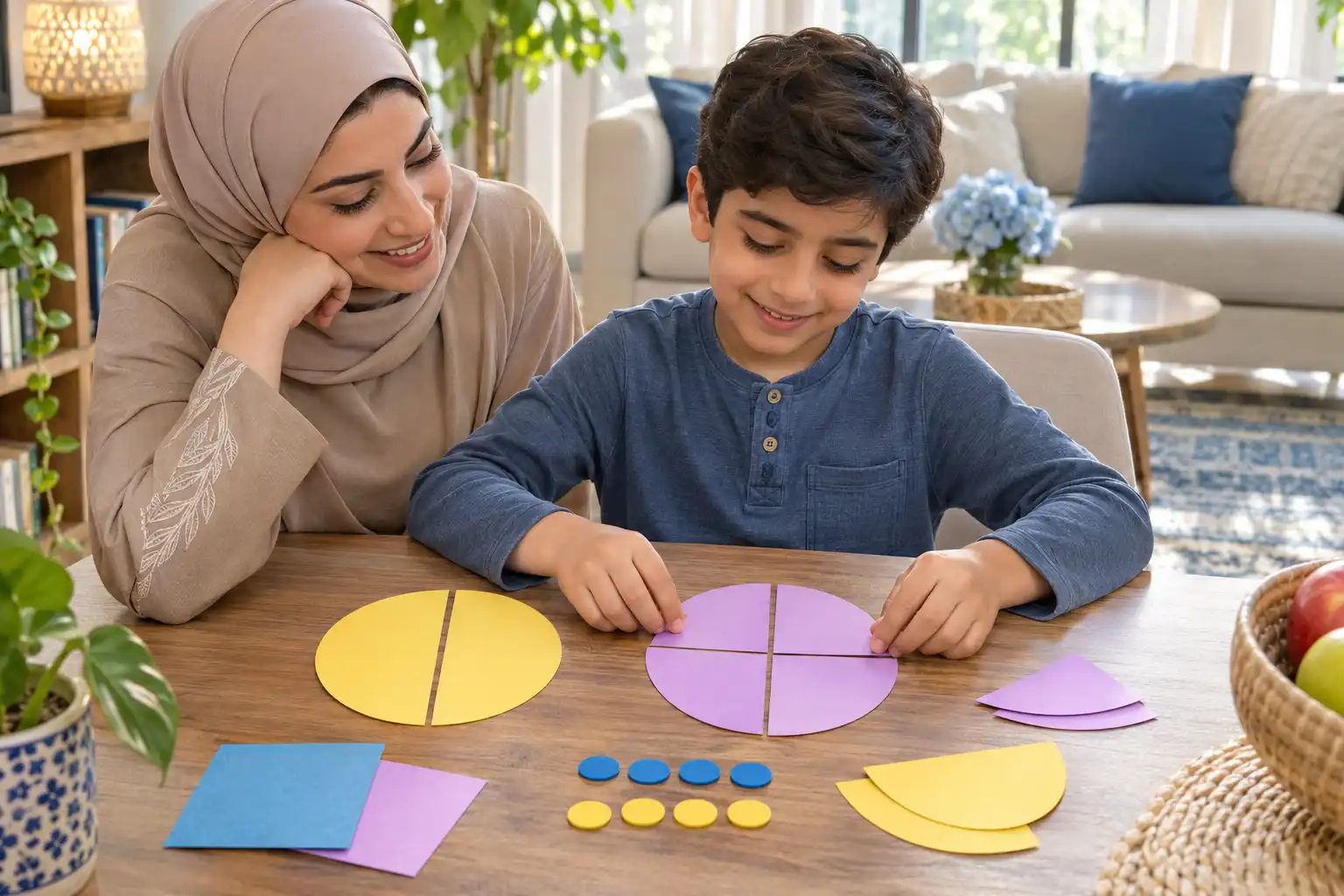
Draw a rectangle on paper and call it one whole. Fold or divide it into two equal parts. Shade one part and name it one half. Repeat with a second rectangle divided into four equal parts to introduce quarters.
Keep the size of the whole consistent when comparing these examples. A tiny paper shape and a large sheet can distract from the relationship you want the child to understand. Ask, “How many equal parts make this whole?” before introducing more notation.
Explain the numbers in a fraction
In one quarter, the denominator 4 describes the number of equal parts in the whole. The numerator 1 describes how many of those parts are being considered. Shade three of the four parts and ask the child to describe three quarters. Connect the words, picture and symbols instead of teaching them separately.
Show that fractions can describe groups
Arrange eight counters in two equal groups. One half of the collection is four counters. Rearrange the same collection into four equal groups; one quarter is two counters. Make clear that the whole is now the full collection of eight, rather than one individual counter.
Try a number line
Draw a line from 0 to 1 and place one half halfway along it. Add quarters and ask which points share a position. Two quarters and one half meet at the same point. This provides a visual starting point for equivalent fractions without beginning with a rule to memorise.
Check understanding with a different example
Ask your child to show one half in two ways, explain why unequal pieces are not quarters of that whole, or find one quarter of twelve counters. Choose tasks that match the concept already taught in the child’s grade.
At VOnline School, parents can connect these practical activities to the structured concept lesson and related quiz. The later Grand Assessment belongs to a grading system focused on learning outcomes and skills, so being able to explain a new example matters alongside completing lesson activities.
Should I start with fraction calculations?
First check equal parts, the whole and the meaning of the notation. Move to calculations when the relevant lesson introduces them.
Next step: Explore grade options at Explore classes and learning options and current programme fees at View current fees