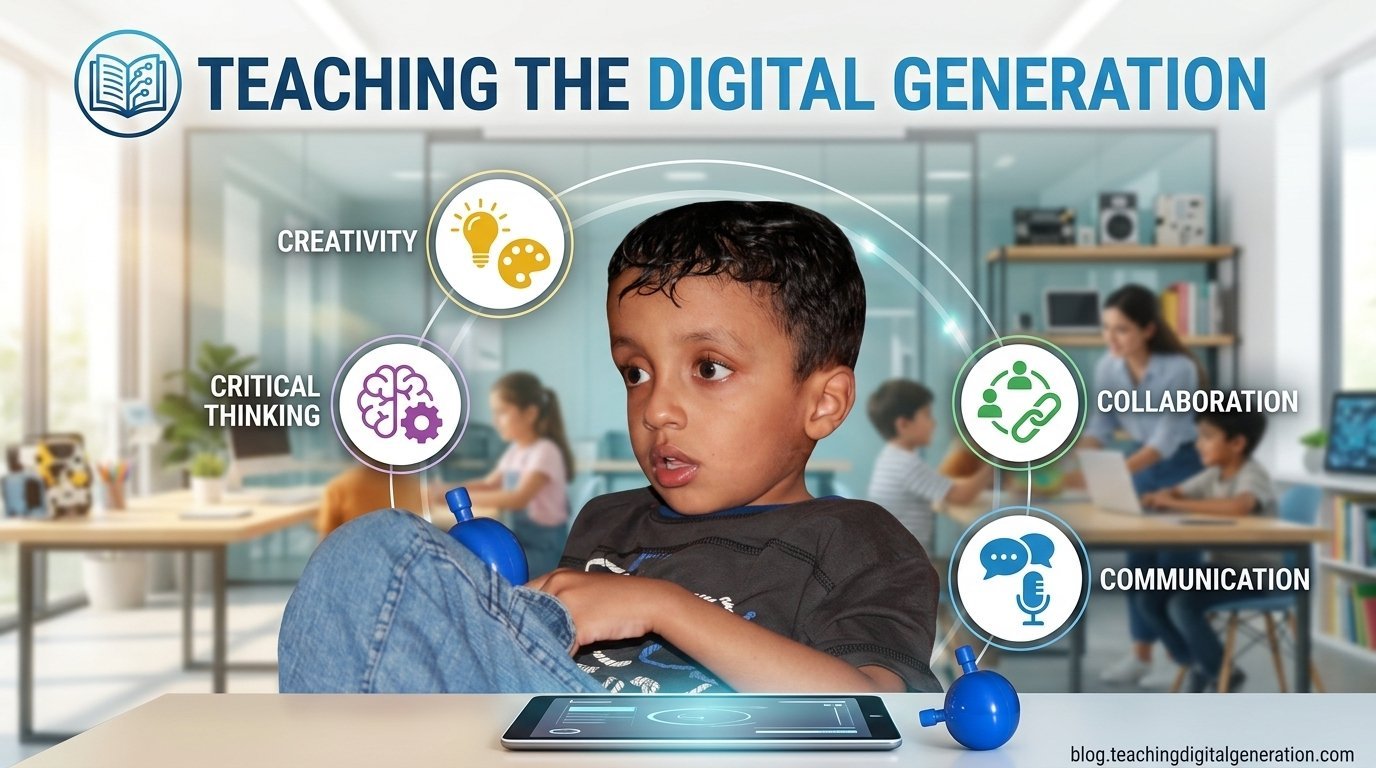
Ultimate Guide to 21st Century Skills for the Digital Generation
21st century skills are essential for guiding children through the realities of modern education and the digital landscape. A child asks a question. What happens next? A few years ago, the answer might have been, “Let’s look it up in a book.” Today, the child may search online, watch a video, ask an AI tool, explore an interactive simulation, or discuss the question with someone thousands of kilometres away. This is the world of the digital generation.
Today’s learners are growing up surrounded by technology. Digital devices, online platforms, artificial intelligence, and instant access to information are shaping how they communicate, explore, and learn. But living in a digital world does not automatically mean that students have the skills to thrive in it.
The real question is: Are we simply teaching children to use technology, or are we teaching them how to use it wisely, creatively, safely, and purposefully? That is the “challenge” and “opportunity” of 21st century education.
More Than Digital Skills Being able to use a smartphone, search the internet, or open an application does not necessarily make someone digitally literate. True digital literacy means knowing how to:
-
Find reliable information.
-
Question what we see and read online.
-
Communicate responsibly.
-
Protect personal information.
-
Use technology safely and ethically.
-
Create meaningful digital content.
-
Use digital tools to solve problems.
In other words, students should not only be consumers of technology. They should also become critical thinkers, responsible digital citizens, and creative problem solvers.
Mastering 21st Century Skills: Critical Thinking
The internet gives learners access to an enormous amount of information. But not everything they see online is accurate, useful, or trustworthy. Students need to learn to ask:
-
Who created this information?
-
Is the source reliable?
-
Is there evidence to support this claim?
-
Can I verify this information elsewhere?
Teaching students to question, analyse, and evaluate information is one of the most important skills of the digital age and to impart 21st century skills among them. For deeper insights into modern educational frameworks, you can explore the Framework for 21st Century Learning.
Creativity: From Watching to Creating
When we talk about 21st century skills,Technology gives students the opportunity to become creators. Instead of only watching videos, can they create one? Instead of only playing a game, can they design a simple solution? Instead of simply copying information, can they present an original idea? Digital tools can support creativity through storytelling, design, coding, presentations, multimedia projects, and problem solving activities. The future needs creators not only consumers.
Communication: Connecting with Purpose
Digital communication is now part of everyday life and 21st century skills. Students need to know how to express their ideas clearly and respectfully in different digital spaces. A useful question for every learner is: Would I say this in the same way if the person were sitting in front of me? Teaching respectful communication, empathy, and appropriate online behaviour helps students become responsible members of digital communities.
Collaboration: Learning Together, Even from a Distance
The ability to work with others is no longer limited by physical location. Students can discuss ideas, complete group projects, share resources, and solve problems together through digital platforms. But collaboration is more than dividing a task. It requires learners to listen, contribute, respect different opinions, and work towards a shared goal. Can our students work effectively with others—even when they are not in the same room? That is a key 21st century skills.
Problem Solving: Learning to Find Solutions
Tomorrow’s world will present challenges that cannot always be solved by memorising a textbook answer. Students need opportunities to investigate problems, test ideas, learn from mistakes, and develop solutions. A powerful learning question is: “What can we do about this?” Whether students are solving a mathematical problem, designing a project, or addressing a real life challenge, problem solving helps transform knowledge into action. This will prepare them for 21st century skills
Adaptability: Learning, Unlearning, and Relearning
Technology is changing rapidly. The tools students use today may look very different tomorrow. Therefore, one of the most valuable skills is the ability to adapt. Students should become comfortable with learning new things, changing their approach, accepting feedback, and trying again when something does not work. The most successful learners of the future may not be those who know everything. They may be those who are most willing to keep learning.
Digital Citizenship: A Skill Every Learner Needs With digital opportunities come digital responsibilities. Students need guidance on:
-
Online safety and privacy
-
Respectful online behaviour
-
Responsible use of social and digital platforms
-
Identifying misinformation
-
Understanding their digital footprint
-
Using artificial intelligence ethically
-
Maintaining a healthy balance between screen time and other activities
The question is not whether children will enter the digital world. They already have. Our responsibility is to help them enter it with awareness, confidence, and responsibility.
What Does 21st Century Teaching Look Like? A 21st century classroom physical or virtual is not simply a classroom filled with devices, it should focus on 21st century skills. It is a learning environment where students are encouraged to:
-
Ask → questions
-
Explore → ideas
-
Think → critically
-
Create → solutions
-
Collaborate → with others
-
Communicate → clearly
-
Reflect → on their learning
-
Apply → knowledge to real life
Technology becomes a tool not the purpose of learning.
A Quick Challenge for Parents and Educators Ask yourself these three questions:
-
Are children only receiving information and ready for adapt to 21st century skills, or are they learning how to question it?
-
Are they only using technology, or are they creating with it?
-
Are they preparing for the next examination, or for the challenges of the future?
The answers can help us rethink how we teach the digital generation.
Preparing Learners for a Changing World , when we are talking about 21st century skills, At our Online School System, we believe that preparing students for the future requires more than academic success. Learners need knowledge, but they also need the skills to use that knowledge wisely. By combining strong academic foundations with critical thinking, creativity, communication, collaboration, problem-solving, digital literacy, and responsible citizenship, education can help students become confident and capable learners.
The goal is not to predict exactly what the future will look like. The goal is to prepare learners for 21st century skills who are ready to face whatever the future brings. Because in the 21st century, the most important skill may be the ability to keep learning.
You may also like to read this: The Power of Personalized Learning

You may also like