Grade 3 Homeschooling: Learning Outcomes and How to Succeed
Grade 3 homeschooling gives children more opportunities to explain what they read, organise a paragraph and use mathematics to solve a problem. Parents searching for Grade 3 online classes should look for that connection between content and understanding, alongside practical teacher and family support.
This parent guide explains the significance of Grade 3, the skills your child will work towards and practical ways to support explaining answers and connecting ideas. It is based on V Online School’s published Grade 3 learning outcomes. Suggested home activities below are examples for families, rather than additional promised school services.
Why Is Grade 3 Important?
In Grade 3, learning becomes easier to discuss when a child can show the steps behind an answer. A topic sentence helps organise writing; a graph turns quantities into information; a science explanation connects an observation with an idea. These are useful foundations for the longer tasks that follow in later grades.
What reading and writing outcomes does Grade 3 cover?
The school lists passage questions, longer paragraphs with topic sentences, pronouns, prepositions and simple tenses. Homophones and compound words extend vocabulary, while conversation and role-play support speaking. A useful check is to ask the child to explain a paragraph’s central point and identify a detail that supports it, using their own words.
Which Grade 3 maths skills should parents review?
Published outcomes include three-digit addition and subtraction, multiplication tables up to 6, division as repeated subtraction, fractions, lines, angles, symmetry and reading bar graphs. Look beyond speed: can the child represent the operation and explain which one a word problem needs? If a fraction comparison is unclear, use equal-sized paper shapes to discuss the parts.
What do science and computer learning add?
Science covers plant structures, animal diets, states of matter, simple machines and pollution. STEAM includes keyboarding, input and output devices, storage, basic word processing and web searches, alongside drawing and perspective. Together, these outcomes connect explanation with presentation: a child can observe a lever, describe its action and organise a short document about it.
How Can My Child Succeed in Grade 3 at Home?
- Ask for a short explanation after reading instead of relying only on a correct multiple-choice answer.
- Practise multiplication relationships and division with objects when needed.
- Break writing into a topic sentence, supporting details and a final check.
- Read simple graphs together and ask what the data does and does not show.
- Save questions that remain unclear and discuss them with the teacher or school.
Use the plan flexibly. If a task is consistently too difficult, bring examples to the school and identify the missing skill. Finishing a lesson and understanding its learning outcome are related, but they are not identical.
What Does Learning Look Like in Practice?
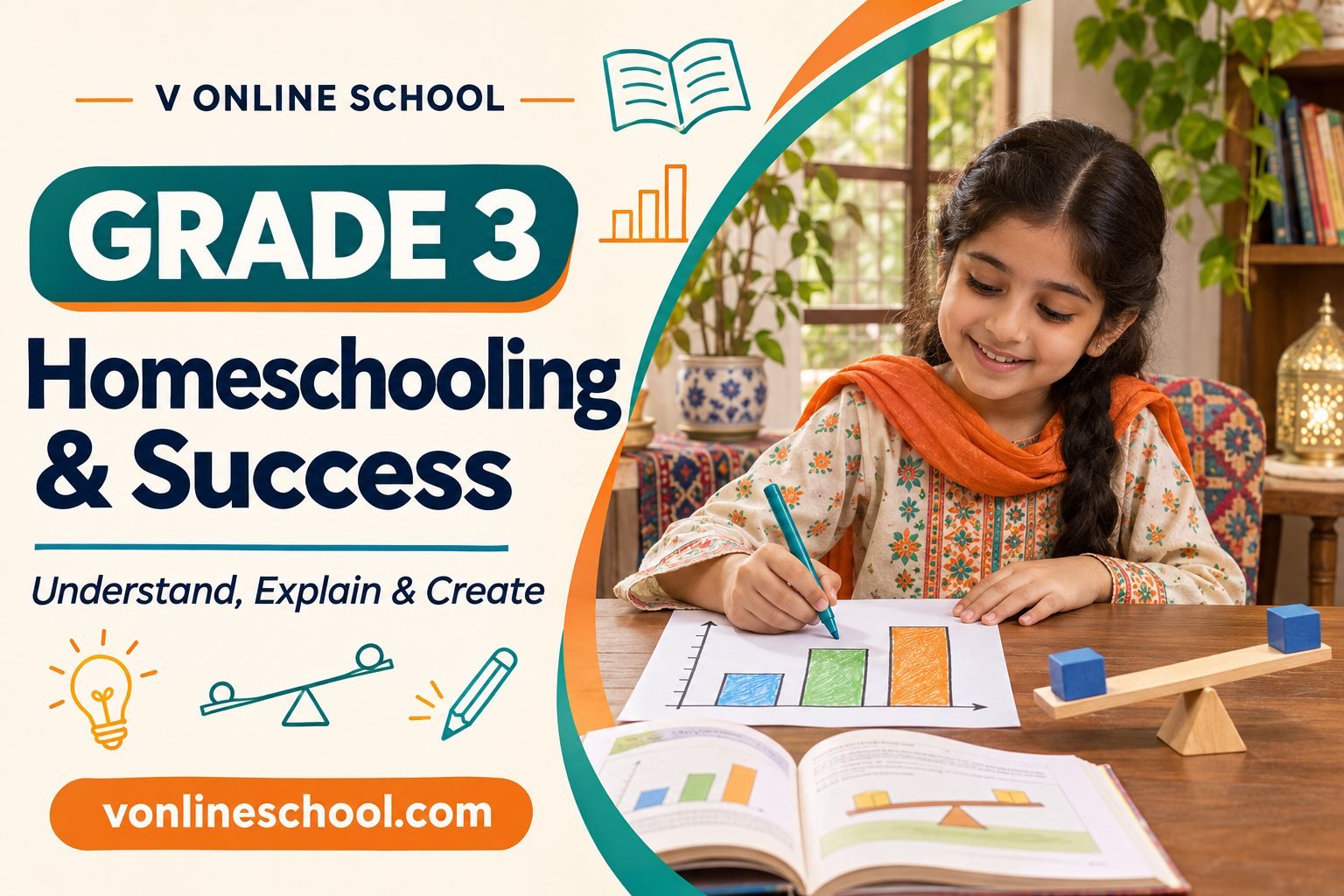
Make a simple bar graph showing favourite fruits in your household. Ask your child to write a paragraph describing the result and explain how they counted the responses. This suggested activity combines data handling, writing and checking evidence.
How V Online School Teaches and Assesses Grade 3
Each concept has a structured lesson followed by a related quiz. Passing that quiz moves the learner to the next lesson. After all lessons in the sequence, the learner completes the Grand Assessment. Performance is reflected in a grading system based on learning outcomes and skill-based assessment, including understanding and application.
The same learning pathway is available through three options:
- Self-Paced Individual Learning: the child follows the system at their own speed, with the home support they need.
- Live Online Group Class: a teacher coordinates the group on Zoom, shares the system lessons and quizzes on screen and explains concepts.
- One-to-One Tuition: a teacher guides one learner through the same lessons and quizzes on Zoom, with individual explanation and practice.
Compare these options in our self-paced versus live online classes guide. Choose according to the learner’s needs, available support and family routine. Ask about actual session arrangements instead of assuming that every option has the same timetable.
Grade 3 Homeschooling Questions Parents Ask
How can I help a Grade 3 child who reads but does not understand?
Use a shorter section, explain important vocabulary and ask the child to retell the meaning. Discuss specific examples with the school so support addresses the difficulty rather than simply assigning more pages.
How do I know Grade 3 homeschooling is working?
Look across different tasks: independent reading explanations, organised paragraphs, reasoned calculations and accurate observations. Use the school’s outcome-based grading alongside conversations about the work.
How much do Grade 3 online classes cost?
Fees depend on the chosen learning option and applicable category. Check the current fee structure for amounts, currencies and renewal rules. This keeps your decision based on current information.
Explore Grade 3 and Plan the Next Step
Review the full Grade 3 subjects and learning outcomes, compare fees and contact the school about your child’s starting point. Registration gives immediate dashboard access. Pay the applicable fee and upload the receipt; the school manually reviews it before granting class access. Monthly plans require renewed payment and a new fee slip.
Success starts with a clear next learning goal, purposeful practice and support when it is needed. Use what your child can explain and apply to guide the next step.

You may also like

Grade 10 Online Homeschooling: Learning Goals, Success and Next Steps

Grade 9 Online Homeschooling: Subjects, Study Success and Exam Planning