
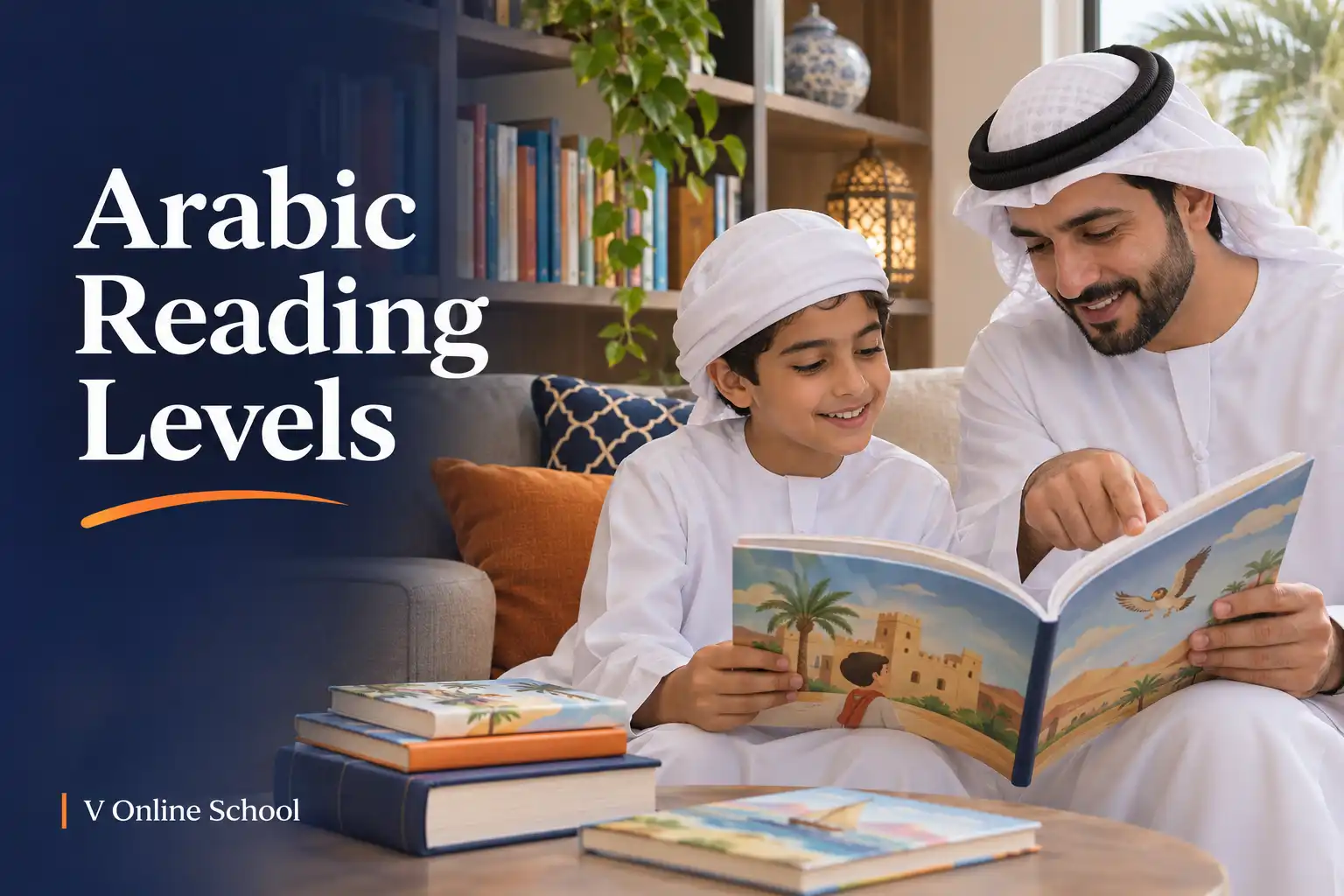
Arabic Reading Levels: 5 Ways Gulf Parents Can Choose Better Books
Education news and parent guide · Updated 24 November 2026
On 17 November 2026, Emirates News Agency reported that Alef Education and MetaMetrics had developed Miqyas Al Dhad, a scale for Arabic reading proficiency and text complexity. The announcement highlights matching reading material to a learner’s developing abilities. Read the source announcement.
How can Arabic reading levels guide book choices?
Arabic reading levels can help families choose material that stretches a child without making every sentence a struggle. Age and school grade are useful starting points, but they do not describe every learner’s vocabulary, decoding or comprehension. A child learning Arabic as an additional language may need different support from a fluent speaker of the same age.
The new announcement concerns a specific measurement system. Parents should not invent a scale score from a home reading activity or assume every book already carries an equivalent level. The practical lesson is simpler: observe what the child can read and explain, then choose the next text accordingly.
1. Listen to a short sample before buying
Invite your child to read a small passage in a comfortable setting. Notice whether unfamiliar words interrupt every sentence, whether punctuation helps their phrasing and whether they understand the topic. If the passage is too difficult for independent reading, it can still be a good shared book with adult support. Avoid calling the child a weak reader.
2. Check understanding as well as pronunciation
Accurate pronunciation alone does not show full understanding. Ask who the passage is about, what happened and why a character made a decision. For an information text, ask the child to explain one new fact in their own words. Use discussion first if writing would hide what the learner actually understands.
3. Notice vocabulary, sentence length and visual support
Compare two pages rather than choosing solely by the advertised grade. Illustrations, familiar themes, clear layout and repeated vocabulary may make a text more accessible. Long sentences, unfamiliar concepts and dense paragraphs can increase the challenge. For bilingual families, discuss the meaning of a new word without turning each page into a translation exercise.
4. Choose a mix of comfortable and supported reading
Keep some books the child can read with confidence and others you can explore together. A comfortable story supports fluency; a shared, more demanding text can introduce ideas and vocabulary. Let the child’s interests matter. A learner curious about animals may persist with a relevant information book more readily than an unrelated title selected only for its level.
5. Review progress with a repeatable observation
After a few weeks, use another short passage of broadly similar difficulty. Compare the child’s explanation, independence and use of new words. Keep a brief note rather than a public ranking. Progress can include clearer retelling or less adult prompting even when the child has not moved to a new commercial reading band.
What should parents ask about a formal reading score?
Ask what the assessment measures, which language varieties and learner populations it covers, how the score should guide instruction and when reassessment is appropriate. Also ask what a result cannot tell you. A score should lead to a useful teaching decision, such as vocabulary support or a better-matched text, rather than becoming a label attached to the child.
Connecting reading with online learning outcomes
Families in the UAE, Saudi Arabia, Qatar and other Gulf countries often compare online schooling by lesson counts. A more useful question is whether the child can understand and apply the material. At V Online School, the shared pathway uses concept lessons, related quizzes and a final Grand Assessment, with learning outcomes and skills reflected in the grading system. This is a description of our general approach, not a claim that we use or are affiliated with Miqyas Al Dhad.
Frequently asked questions
Should a child always read books labelled for their grade?
No. Consider actual understanding, interests and the amount of adult help needed alongside the school’s guidance.
Can parents calculate a Miqyas Al Dhad score themselves?
A home observation is not an official score. Use the assessment provider’s authorised process for a formal result.
What if my child reads aloud well but cannot explain the story?
Slow down and discuss meaning, vocabulary and connections. Ask the teacher which comprehension skill to practise next.
Explore the right learning option for your child
See our grade subjects and learning outcomes, compare current fees and learning options, or contact V Online School to discuss suitability. Our Islamabad support team is available 9 am–9 pm Pakistan time, with a maximum reply time of 24 hours.

You may also like

Kuwait Book Fair 2026: 7 Ways to Build a Child’s Reading Habit

Online Teacher Qualifications: 7 Questions Parents Should Ask